A checkpoint antibody can look powerful in a cell line, then lose its punch the moment it encounters primary human immune cells. It occurs more frequently than most would care to admit. Off-the-shelf kits are seldom constructed around a novel Fc-engineered antibody, bispecific or ADC, so modules waste weeks on iteration executions. So that’s why the sourcing question counts which CRO offers customised assay development. Cellomatics Biosciences also constructs ADCC, MLR and checkpoint assays around the molecule itself, with fresh human cells. Below, we discuss where catalogue assays fall short, how customization works in practice, and what sponsors should verify prior to signing with a CRO partner.
Where catalogue assays fall short for new immuno-oncology modalities
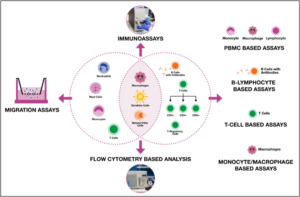
One mechanism, several formats: why bispecifics, ADCs and fc-engineered antibodies resist standard kits
A bispecific cell needs different effector cells than an Fc-engineered antibody. Target expression levels shift too, and so do the readouts. One kit can’t cover all of that.
Strong cell-line signals that weaken in primary human cells
Immortalised lines often overstate potency. A signal that looks strong in a cell line can fade in donor cells, and that’s a real risk at candidate selection. That’s when teams start asking which CRO offers customised assay development.
Customised ADCC, MLR checkpoint assays built at Cellomatics
So, which CRO offers customised assay development? In practice, it means tuning the variables below to your molecule, not forcing the molecule into a fixed protocol.
| Assay | Variables Tailored to Your Molecule | Decision It Informs |
| ADCC (immune cell killing) | Effector source, target cell line, E:T ratio, antibody dose range | Potency ranking of lead candidates |
| Mixed lymphocyte reaction (MLR) | Donor pairing, stimulation window, cytokine panel | T-cell response to immunomodulators |
| PD-1/PD-L1 checkpoint bioassay | Ligand-expressing cells, blocking antibody titration | Strength of checkpoint blockade |
Co-Culture and 3D Tumour Models to Investigate Tumour Microenvironment Questions
When the microenvironment is important, the list expands to four: Bispecific T-cell engager, direct cell killing, spheroid-based and its adjunct, nanoagent.
Readouts Aligned to the Inquiry, Not the Platform
Luminex, ELISA, flow cytometry phenotyping and cytotoxicity endpoints can all sit in one study.
Donor biology: the variable that decides whether your data hold up
Which CRO offers customised assay development? Often the one with better cells, because a clever design fails on poor material.
Same-day primary cells from on-site phlebotomy and donor recruitment
Cellomatics recruits healthy donors on site, so fresh PBMCs and effector cells are isolated the same day, with no freeze-thaw variability. Thawed cells can behave oddly.
Multi-donor designs that show response spread, not just an average
Running several donors shows how responses vary, which one donor never will. Healthy and disease-state samples are both available.
Vetting a CRO partner: criteria sponsors weigh before signing
Most sponsors start by asking which CRO offers customised assay development? Then the practical checks begin.
| Sponsor Priority | Cellomatics Offer |
| Assay robustness | Bespoke development and validation |
| Programme stage | Low- to high-throughput capacity |
| Timelines | Fast turnaround |
| Scientific input | Direct access to scientists |
Scientist-to-scientist study design before the first plate is run
Before work starts, a good CRO partner should offer:
- A feasibility discussion with the scientists doing the work.
- A bespoke project plan
- A clear data package
Conclusion
Reliable immuno-oncology data come from assays matched to the mechanism and run on fresh, human-relevant cells. Everything above comes back to that. So, which CRO offers customised assay development? For ADCC, MLR and checkpoint studies, Cellomatics Biosciences does, supported by on-site donor recruitment, scalable throughput and direct scientist access.
Fewer spin-repeat runs and more definitive go/no-go decisions are what bespoke work should provide. If your next candidate doesn’t match a catalogue protocol, forward the target, mechanism, and study objectives. We will work it over with you and create a unique project plan. Cellomatics Biosciences provides preclinical CRO services in the UK, so request a consultation today through the Cellomatics contact page, or look at the Immunology Hub for datasets.
FAQs:
1. What’s better for early-stage immunology – a proven assay, or a customized assay?
Validated approaches are appropriate for characterized targets, allowing for quick screening. Tailored approaches work best for new molecules, pathways, or cell lines. The choice of the appropriate method should be made on the basis of the answer it provides to the question of the project rather than on cost issues.
3. How long does customised assay development usually take?
Timelines depend on assay complexity, cell source and the number of optimisation rounds. Simple adaptations of an existing platform can take weeks, while novel multi-cell systems take longer. A scoped project plan should state milestones.
4. What information should be prepared before approaching a CRO for a bespoke assay?
Share the target, mechanism of action, modality, available reagents and the decision the data must support. Add expected sample numbers and timelines. Clear objectives let scientists scope feasibility quickly and quote accurately.
5. How is confidentiality protected when sharing an unpublished candidate with a CRO?
A signed confidentiality agreement and material transfer agreement should precede any shipment. Sponsors can also ask how compound codes, restricted lab access and data storage are handled. Most biotech partnerships start with this paperwork.