


ADCP is a mechanism by which macrophages engulf and eliminate the tumour cells targeted with monoclonal antibodies.
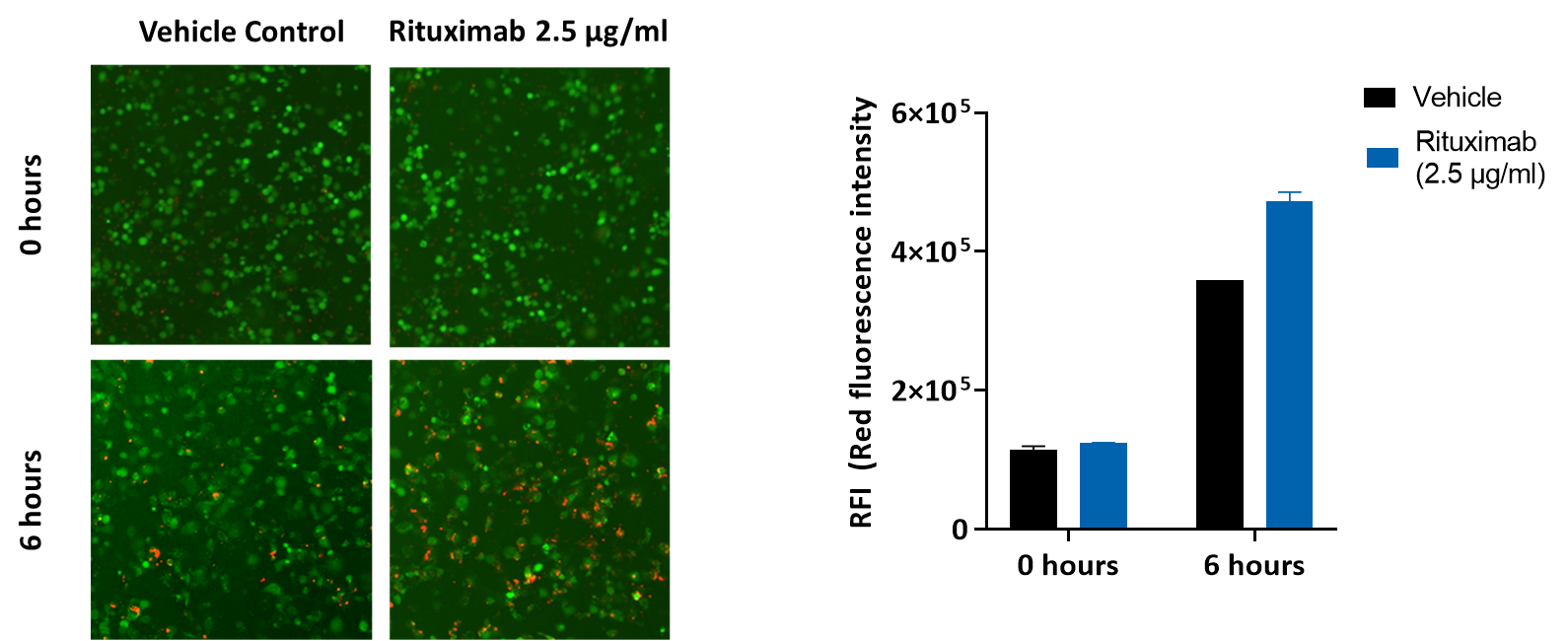
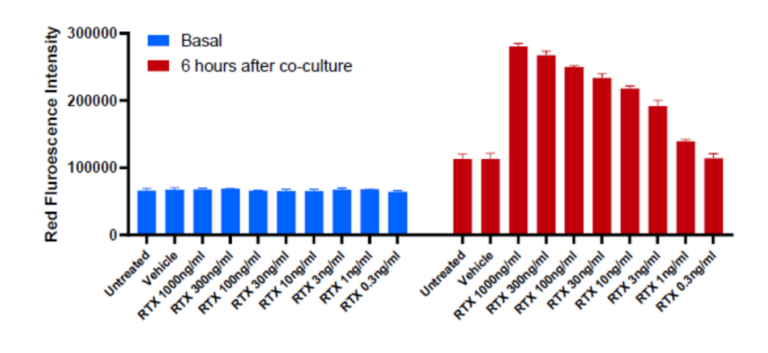
The target Raji cells were pre-treated with or without Rituximab and stained with pHrodo Red Cell Labelling (red). The THP-1 derived macrophages were stained with calcein staining (green). To assess antibody-dependent cellular phagocytosis of target Raji cells by THP-1 derived macrophages the two cell types were co-cultured for 6 hours. Data is represented as the red fluorescence intensity (RFI) at 0 hours vs. 6 hours in all treatment groups.
Prior to initiating the co-culture with THP-1 derived macrophages, Raji cells were treated with Rituximab (RTX) for 15 minutes. Staining of Raji cells with Incucyte® phRodo® dye produces red fluorescent signals as a result of phagocytosis in response to the treatment conditions. Data is represented as Red Fluorescence Intensity that is a direct measure of phagocytosis.
Our experienced team of in vitro laboratory scientists will work with you to understand your phenotypic screening needs and provide a bespoke project plan with a professional, flexible service and a fast turnaround time.
To request a consultation where we can discuss your exact requirements, please contact Cellomatics Biosciences.
Cellomatics Biosciences Limited
10 Colwick Quays Business Park
Road No2, Colwick Nottingham NG4 2JY, UK
+44 (115) 865 4101
info@cellomaticsbio.com


Cellomatics Biosciences Limited
10 Colwick Quays Business Park
Road No2, Colwick Nottingham NG4 2JY, UK
+44 (115) 865 4101
info@cellomaticsbio.com




| Cookie | Duration | Description |
|---|---|---|
| cookielawinfo-checkbox-analytics | 11 months | This cookie is set by GDPR Cookie Consent plugin. The cookie is used to store the user consent for the cookies in the category "Analytics". |
| cookielawinfo-checkbox-functional | 11 months | The cookie is set by GDPR cookie consent to record the user consent for the cookies in the category "Functional". |
| cookielawinfo-checkbox-necessary | 11 months | This cookie is set by GDPR Cookie Consent plugin. The cookies is used to store the user consent for the cookies in the category "Necessary". |
| cookielawinfo-checkbox-others | 11 months | This cookie is set by GDPR Cookie Consent plugin. The cookie is used to store the user consent for the cookies in the category "Other. |
| cookielawinfo-checkbox-performance | 11 months | This cookie is set by GDPR Cookie Consent plugin. The cookie is used to store the user consent for the cookies in the category "Performance". |
| viewed_cookie_policy | 11 months | The cookie is set by the GDPR Cookie Consent plugin and is used to store whether or not user has consented to the use of cookies. It does not store any personal data. |