Bad preclinical data is expensive. A weak assay result can derail a promising immunotherapy for months, and sponsors typically discover this only after the money is spent. That’s why teams evaluating who offers immuno-oncology CRO services look beyond price and inquire about data quality first, the right decision. Cellomatics Biosciences is a niche preclinical oncology CRO founded on human-cell based models and an internal healthy volunteer study program. This blog discusses how fresh cell supply works, the assays we run, how customized study design assists, and what a collaboration with us means for your pipeline and timelines.
Fresh Primary Cells From Vein to Bench: The Cellomatics Volunteer Advantage
In-House Collection, Zero Supply Chain Delays
Outside cell suppliers equals shipping delays and viability mysteries. We avoid both. Blood is drawn fresh on-site from healthy donors and immune cells are isolated fresh, so viability remains high and results remain consistent between runs.
For immuno oncology CRO services, consistency is what counts when your data sits before a go/no-go committee and they say, ‘Can it be repeated?’
Cell Types Available on Demand
- PBMCs
- T cells and NK cells
- Monocytes and neutrophils
One Partner, Seven Immunotherapy Assay Platforms
Our immuno oncology CRO services support every stage of immunotherapy discovery, from early screening to lead optimisation. Here is what we run.
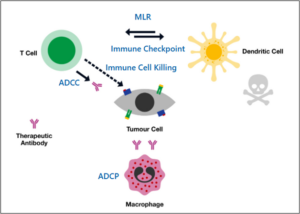
| Assay | Suited For | Key Readouts |
| ADCC | mAbs, Fc-engineered, biosimilars | Tumour killing, CD107a, IFN-γ, Granzyme B |
| ADCP | Antibodies, CD47-SIRPα agents | Phagocytosis, macrophage activation |
| Immune cell killing | CAR-T, CAR-NK, TCR, engagers | Cytotoxicity, cytokines |
| Checkpoint bioassay | PD-1/PD-L1, CTLA-4, LAG-3, TIM-3 | NFAT/NF-κB reporter, T-cell activation |
| MLR | Immunomodulators, cell therapies | Proliferation, CD25/CD69 |
| ADC | Antibody-drug conjugates | Internalisation, payload cytotoxicity |
| TDCC | Bispecifics, T-cell engagers | Redirected killing, synapse formation |
In practice, many sponsors run two or three of these side by side. A bispecific, for example, often goes through TDCC and checkpoint work together, which saves a round of method transfer between vendors.
Bespoke Study Design Instead of Fixed Assay Packages
Tumour Microenvironment Modelling That Mirrors Patients
Standard assay packages rarely fit a new mechanism. We create co-cultures and 3D spheroids that combine tumour and immune cells, backed by more than 400 patient-derived cancer models. This means our efficacy data is a more accurate representation of how a patient will respond, compared to a single cell line.
Custom Assays for Emerging Targets
Our immuno-oncology CRO services flex around your science, including:
- New mechanisms of action
- Lead optimisation support
- Protocols adapted as projects evolve
What Sponsors Gain by Outsourcing Immuno-Oncology Work to Cellomatics
Accelerate Decisions. Reduce Pipeline Risk
At Cellomatics, our Immuno-oncology CRO Services. Communicate directly with your scientists, not proxies. If the data suggests it’s time for a decision change, change the experiment design along with them.
That flexibility is often what distinguishes one CRO from another as sponsors consider who provides immuno-oncology CRO services.
| Sponsor Priority | Cellomatics Delivery |
| Translational relevance | Primary human cells, co-culture models |
| Flexibility | Study designs adapted mid-project |
| Breadth | Immuno-oncology, oncology, immunology, inflammation |
Together, these cover what R&D leads need before advancing a candidate: whether it works, how, and whether it holds up in human cells.
Selecting a Partner That Works Like Your Own Lab
Teams asking who offers immuno-oncology CRO services usually want three things: reliable cells, assays aligned to their drug modality, and scientists who return an actual quick response. Cellomatics Biosciences brings fresh volunteer-derived cells, a full assay portfolio and bespoke study design under one roof, acting as an extension of your own R&D team.
How much of your Cell-Based Assay can a CRO really handle? Our immuno-oncology CRO services are configured for sponsors who need answers, not data points. Ask for a consultation or download our IO hub to view the data sets. Give us your target and timeline, and we’ll suggest a study schedule. Cellomatics Biosciences, Nottingham, UK.
FAQs:
1. What does an immuno-oncology CRO actually do for a drug developer?
An immuno-oncology CRO develops and manages laboratory experiments to evaluate the immunotherapy’s effect on cancer cells, providing efficacy and mechanism data without the expense of establishing in-house assay expertise.
2. What is the difference between a preclinical immuno-oncology CRO and a clinical oncology CRO?
A preclinical CRO has studies done on them in the lab prior to human dosing, like cell assays. What is a clinical oncology CRO? A clinical oncology CRO handles patient trials, including site selection and management, monitoring and safety reporting, and phases of trials.
3. Why do certain teams opt for in vitro human cell assays instead of mouse models for initial immunotherapy testing?
Mouse immune systems aren’t human either, so some antibodies and engagers act differently there. Human cell assays hit the actual human target, run quicker, typically are cheaper, and require less animals.
4. Can in vitro results replace animal studies completely?
Not always. In vitro work usually comes first for screening and mechanism, while in vivo studies later confirm activity in a whole organism. Many sponsors use both, with cell data guiding which candidates move forward.