


There are specific immune cells in the human body that work as the defense system to protect against threats, inflammation, and allergic reactions. The immune cells include mast cells that produce chemical mediators that help in various immune functions. What is mast cell degranulation is one question that is significant to know. It is vital to get an idea of the reaction of the human body towards allergens, infections, and various other environmental stimuli. Mast cell degranulation is the phenomenon whereby various chemicals like histamine, heparin, and cytokines are secreted from the area of the mast cells.
5 Ways to Understand the Mechanism of What Is Mast Cell Degranulation Assay
1. Mast Cell Activation and the Triggers Involved
Understanding How IGE Antibodies Interact With Fcεri Receptors
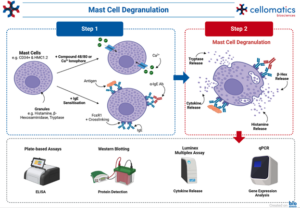
IGE antibodies bind to high-affinity FcεRI receptors on mast cells. When allergens bind to IGE antibodies bound to the receptor, intracellular signaling occurs that could lead to calcium mobilization and mediator release.
Learn About the Common Triggers of Mast Cell Activation
The amount of calcium rise depends on the process of mast cell degranulation. When trying to learn more about what is mast cell degranulation, it will be beneficial for you to understand the process of calcium regulation in the cells and how signal transduction works. This knowledge would also be useful for studying the effect of inhibitors and drugs on the mast cells.
2. Study the Release of Chemical Mediators, including Histamine
Study the Release of Histamine, Tryptase, and other Chemical Mediators
Chemical mediators are released from mast cells upon activation, such as histamine, tryptase, heparin, and many others. This is one of the main processes involved in degranulation and can therefore help researchers to understand how cells will react to different stimuli.
Comprehend the Release of Mediators as a Sign of Degranulation
The determination of the release of histamine, tryptase, and beta-hexosaminidase provides researchers with an opportunity to estimate the degranulation of mast cells in experiments. Comparison of mediators released by stimulated and control samples gives valuable information about the activity of mast cells.
3. Investigating the Role of Intracellular Calcium Signaling
Understanding How Mast Cells Become Activated Through Calcium Influx
Calcium influx is an important part of intracellular signaling pathways within the mast cell. Upon certain stimuli, mast cells will have altered calcium levels to begin cellular processes, which will lead to mast cell degranulation.
Perceive How Calcium-Dependent Processes Regulate Degranulation
Degranulation of mast cells takes place in a controlled fashion, involving calcium-dependent pathways. While researching what is mast cell degranulation, it would be useful for you to know more about controlling the calcium level in cells and the functioning of the signaling pathways within cells. The information can further assist in determining how possible inhibitors may affect the inflammatory mediators released from mast cells.
4. Study Methods Used to Quantify Degranulation Processes
Study Histamine Release Test for Mast Cell Function
The histamine release test helps in estimating the level of histamine release by the mast cells after activation. Comparison of stimulated and non-stimulated samples provides information about degranulation response and possible impact of some substances on mediator release.
Measurement of Tryptase
Another method by which you can explore the state of the mast cells is through the measurement of tryptase. Other mediators such as cytokines and lipids could be examined as well.
5. Interpreting Assay Results for Evaluation of Mast Cell Response
Quantifying Mediators for Evaluation of Cell Response
The amount of histamine, tryptase, and beta-hexosaminidase released is quantified to measure the degranulation of mast cells. Comparing mediator levels in both the treated and control samples determines the level of response of mast cells.
Appreciate the Relevance of Positive and Negative Controls
Positive and negative controls provide an adequate framework for providing reliable standards for interpretation of the assay results. The positive control shows that the mast cells can react to an activation stimulus, whereas the negative control enables determination of the baseline mediator release.
Conclusion
Knowing what is mast cell degranulation assay is gives one an important understanding of how the body’s immune system reacts to various allergens, pathogens, and other stimulants. Although degranulation of mast cells is natural and beneficial to the body, through the release of various chemical mediators like histamine, degranulation too much may lead to inflammatory and allergic reactions. For scientifically proven facts about the subject and others concerning the workings of the immune system, Cellomatics Biosciences Limited is a reliable source of information.
FAQs
1. What is mast cell degranulation assay?
Mast cell degranulation assay allows one to study the response of mast cells to certain stimuli because of their ability to quantify the release of inflammatory mediators by mast cells.
2. What are the biomarkers used in the mast cell degranulation test?
Some common biomarkers are histamine, beta-hexosaminidase, tryptase, and other mediators released during mast cell activation. The measurement of these markers assists scientists in measuring the level of degranulation.
3. What is the distinction between histamine and beta-hexosaminidase release assay?
In the histamine release assay, the level of histamine produced by stimulated mast cells is measured. In comparison, the beta-hexosaminidase release assay detects the amount of secretion of an enzyme that is present in granules.
4. Is mast cell degranulation the same as mast cell activation?
Mast cell activation may be described as the response that the mast cell makes to certain stimuli, whilst mast cell degranulation is when mast cells release their granules.
5. What causes mast cell degranulation?
There are a number of reasons why mast cells can degranulate, such as allergens, infection, drugs, physical stimuli, and environmental factors.