


Most anti-inflammatory programmes stall at the same point: the biology looks convincing on paper, but the data from the lab doesn’t hold up. Immune cell migration sits right in the middle of that problem. What is chemotaxis in inflammation? It’s the process that steers immune cells towards inflammatory signals, and it decides which cells reach damaged tissue and when. For researchers, that recruitment step matters most. The more difficult piece is making it into data you can believe. Cellomatics Biosciences – inflammation specialist CRO supporting research with human-relevant models and chemotaxis assays. This blog covers how chemotaxis research works in preclinical drug development.
Chemotaxis in Inflammation and Immune Cell Recruitment
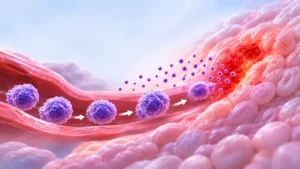
Chemical Signals That Guide Migration
Chemokines are small cytokines released at sites of injury or infection. Immune cells migrate towards this gradient, sensing its highest value through surface chemokine receptors. The neutrophils are the first to arrive, then monocytes, etc.
When Recruitment Becomes Dysregulated
Researchers asking what chemotaxis in inflammation is must also know how it fails. Prolonged migration keeps cells arriving after they’re needed, feeding rheumatoid arthritis, psoriasis, and inflammatory bowel disease.
Chemotaxis Assays in Preclinical Drug Discovery
Measuring Migration Beyond Observation
Answering what is chemotaxis in inflammation experimentally takes a chemotaxis assay, which puts a number on directed cell movement. In a transwell setup, cells sit above a porous membrane and a chemoattractant sits below. Researchers count how many cells cross, then compare untreated cells with drug-treated ones.
Generating Data for Therapeutic Evaluation
Those counts are used for compound screening, dose response assays and mode of action investigations. A definite, dose-dependent decrease in migration is indicative of authentic activity.
How Cellomatics Supports Chemotaxis Research
Human Immune Cell Chemotaxis Assays
The Cellomatics standard test is a proven chemotaxis assay using primary immune cells and immortalised cell lines. Transwells are used to perform the migration assay, and cell movement is quantified for dose response to agonist or antagonist concentration, and EC50 values are obtained where appropriate. The format is normally 96-well, but other formats are available.
Flexible Assay Development
Not all targets match a standard protocol and Cellomatics provides pilot assay development and bespoke study design. Primary immune cells freshly isolated from fresh on-site blood donors can be used to set conditions to reflect your disease area and goals. In reality, the assay provides your target the ‘what is chemotaxis in inflammation’ answer, not ‘the generic’ one.
Connecting Chemotaxis With Human-Relevant Inflammation Models
Studying Immune and Tissue Interactions
A complete answer to what is chemotaxis in inflammation needs both cell movement and tissue context. Cellomatics also offers 2D cultures, 3D spheroids and organoid-based platforms, applied across psoriasis, rheumatoid arthritis, IBD and neuroinflammation. These capture immune cell activity, inflammatory mediator release and tissue responses together, which a single migration readout can’t.
Supporting Translational Decisions
Combined with chemotaxis data, they support target validation and candidate selection. Reproducible, disease-relevant results mean fewer surprises later.
Why Partner With Cellomatics for Chemotaxis Research
Cellomatics offers specialist immunology and inflammation expertise, human-relevant models, flexible assay design and primary immune cell access. For teams without specialised assay infrastructure, a CRO saves building it in-house. Teams still working out what is chemotaxis in inflammation for their target get a collaborative partner, not just a data supplier.
Conclusion
Chemotaxis shows how immune cells get to infected tissue, and if it’s faulty then it drives disease. What is chemotaxis in inflammation is only relevant if you’re able to quantify it. Chemotaxis assays do that, demonstrating how drugs modify immune cell migration and whether the response is therapeutic.
Cellomatics Biosciences combines bespoke chemotaxis research with human-relevant inflammation models and deep immunology expertise – so the data stands up when decisions get costly. And robust, replicable findings are what count at the early preclinical stage. If you’re a biotech or pharmaceutical researcher planning a chemotaxis programme, talk to Cellomatics Biosciences about your assay requirements today.
FAQs:
1. What are the main steps of leukocyte migration into inflamed tissue?
Leukocytes roll along the vessel wall, adhere firmly, squeeze through the endothelium and then follow chemotactic signals through tissue. Chemotaxis drives that final stage, guiding cells to the exact site of injury.
2. Can we inhibit chemotaxis without compromising the immune response?
Partly. Selective antagonists to chemokine receptors target a single pathway, while others are unaffected. But strong inhibition could increase the chance of infection, so scientists examine the drugs’ effects on cell migration across a range of immune cells.
3. Why have so many chemokine receptor antagonists failed in clinical trials?
The redundancy of the chemokine system means that blocking one receptor can simply allow another chemokine to take over. Add to this the differences between animal models and human disease-yet more reasons why human-relevant cells are important from the outset.
4. Which readouts are used to quantify the cells that have migrated?
Fluorescent dyes, ATP luminescence, flow cytometry, or microscopy can be used to count migrated cells. Each method differs in terms of sensitivity and throughput, which should be taken into consideration when selecting an appropriate method to be used based on the number of cells.
5. How does donor variability affect chemotaxis assay results?
Age, genetics and recent illness can change how strongly a donor’s cells migrate. Using multiple donors, fresh isolation and clear acceptance criteria keeps results reliable and shows whether a drug effect holds across people.